hdrop is a little rock, arkansas hydration technology company founded by adria abella villafranca, a former professional tennis player from spain who came to the united states on a scholarship and spent his college seasons cramping through matches despite hydrating before, during, and after matches. the company makes a reusable wearable, no disposable patches or consumables, that reads your sweat while you're moving and tracks sodium loss, sweat rate, and near-skin temperature, then pushes it to your phone or watch in real time. it started as a senior engineering project at harding university in searcy, arkansas, and the first proof that any of it would work involved two paper cups of cafeteria water.
clear urine
adria started playing tennis at ten and turned pro at sixteen, competing on the international tennis federation circuit before a scholarship brought him to oklahoma. two years later he transferred to harding to finish a mechanical engineering degree while still competing and trying to manage southern heat.
arkansas summers are their own kind of test. heat, humidity, long practices, matches that keep going. he was sweating through all of it and cramping constantly, and the confusing part was that he believed he was doing it right. the advice he'd been handed, the same advice athletes have been given for decades, was to drink water until his urine ran clear. so before matches, that's what he did. he drank until it was clear.
what he was likely doing was overdrinking, potentially increasing his risk of dilutional hyponatremia before he even walked onto the court.
i thought i was hydrating properly until i was just cramping all over the place.
— adria abella villafranca, co-founder, hdrop
adria went looking for the why, found the sodium research, worked with a nutrition coach on a plan that put considerably more salt into him during matches, and the cramping stopped. that's the founding catalyst. not a market opportunity spotted from the outside. a problem that was wrecking his own season.
the class
harding requires every engineering senior to pitch an idea, build a team, and deliver a working prototype by the end of the year for a senior capstone. adria had spent close to ten months researching sweat sensing before the class even started, more time in the lab than at tennis practice by his own account, so he arrived with something ready.
the team assembled around the idea. michael cruz, a computer engineer who later became his co-founder and cto. two biomedical engineers. another mechanical engineer, a volleyball player with the same heat and hydration problem. three business students.
other ideas got floated first. a drone. and a walk-in blood testing kiosk you'd find at a walmart, which died the moment somebody in the room made the theranos comparison. the sweat wearable won partly on merit and partly because two collegiate athletes at the table had personally lived the problem.
the professors gave them one month to prove a working sensor was even possible.
two cups of water
the earliest prototype used a simple electrode-based sensor. the core concept proved that changes in sweat could produce a measurable and repeatable signal.
adria could barely write any basic code at that point, so he called michael into the lab for programming know how. michael wrote roughly fifteen lines of code to push an algorithmic signal through the circuit. then they walked to the cafeteria and got two cups of water. one they salted. one they left alone.
they dropped the sensor in each, took readings, and ran it again. and again. two different numbers, consistent every time.
we have something that at least can measure if there's a difference between salty water and not so salty water.
that's the company. two cups of cafeteria water on a lab bench in central arkansas.
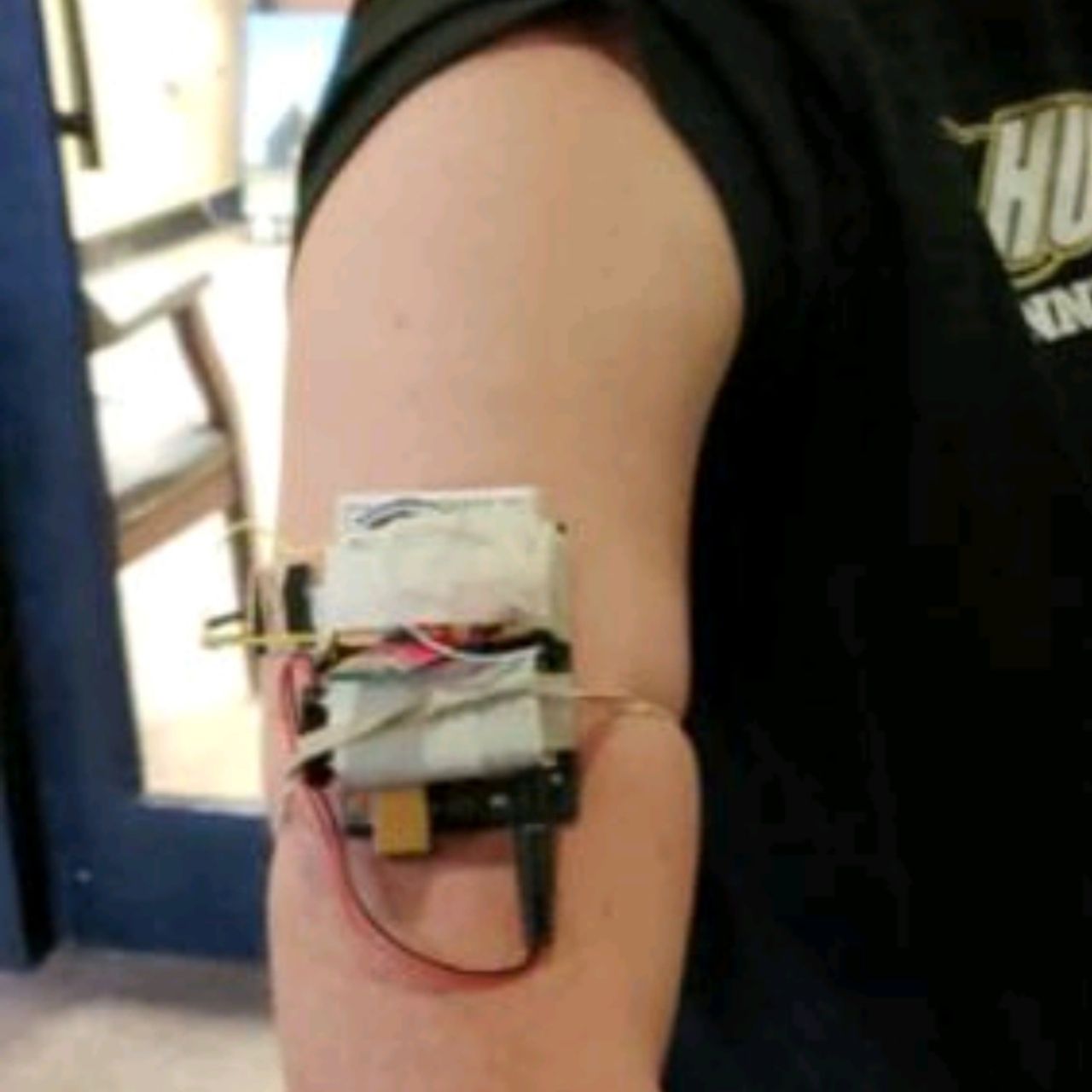
gen 1. the size of a bicep, held on with rubber bands.
not the patch business
when adria was working on this in 2018, the few companies attempting sweat-tracking wearables were building disposable patches. he ruled that out immediately.
we didn't want to be in the patch business.
part of that was product conviction. a patch tells you about one session, and somebody training every day needs something they can put on every day. part of it was that they were broke college students who didn't want to pay for more patches or a subscription, and figured plenty of athletes felt the same. either way it set the design premise on day one. fully reusable, pay once, use it as many times as you want, and read live while you're moving.
that's still the position, and it goes further than patches. no consumables of any kind. nothing to reorder, no refills, nothing to rebuy after the first purchase.
the apartment
after graduation in 2019 they joined an accelerator program that provided the early capital needed to get the project off the ground.
everything that you see on hdrop has been bootstrapped other than the initial investment.
that bought manufacturing materials for gen 1, which adria describes with zero nostalgia. it was the size of his entire bicep and it strapped on with rubber bands.
then the pandemic landed in the middle of product development. the first production units of gen 1 and gen 2 were assembled by hand in his apartment, on plastic folding tables, boxes stacked against every wall. his wife would come over, put on a podcast, and help him build them.
after six months or so you just get tired of doing it over and over and over, but we just pushed through.
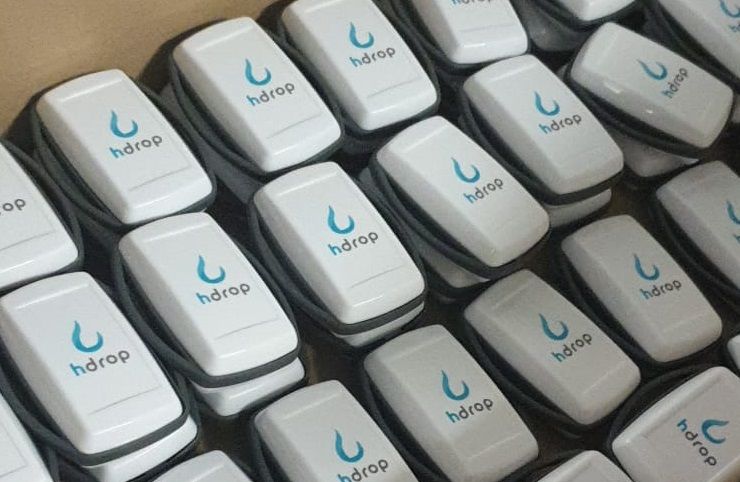
gen 1, before launch.
the kickstarter is where it stopped being an engineering project. adria taught himself ad campaigns, return on ad spend, marketing materials, and production quality control, and got a hard lesson in what running a business off a senior year plan actually is.
adria has a low opinion of business plans generally, which is funny given that the team took an early one to governor's cup, an arkansas pitch competition, listing every market they could think of. tennis, volleyball, military, firefighters, occupational health, elderly care.
when you do a kickstarter, reality hits you in the face. that's when you actually market and that's when all the business plans fall apart. i'm not a big fan of business plans because all of them fail. same thing with financial projections, all the graphs look like hockey sticks but in reality everything looks very different.
what the kickstarter gave them was the one thing no plan had. segmented buyer data. endurance athletes came back as the clearest, most engaged, most commercially serious group on that list, and everything pointed there from then on.
amine mansouri, an electronics engineer and the third co-founder, came in around the two and a half year mark and led the jump from gen 1 to gen 2. adria will tell you gen 2 is significantly better and still not perfect by their standards, but they continue to prioritize upgrades and features as more users come on board.
what it reads
the current device is small, roughly a 30mm square, sits on the upper arm, and runs for well over sixty hours on a charge. it tracks sweat rate, total sweat loss, sodium loss, potassium loss, and near-skin temperature, live, and sends it to the hdrop app. gen 2 runs $249.99.
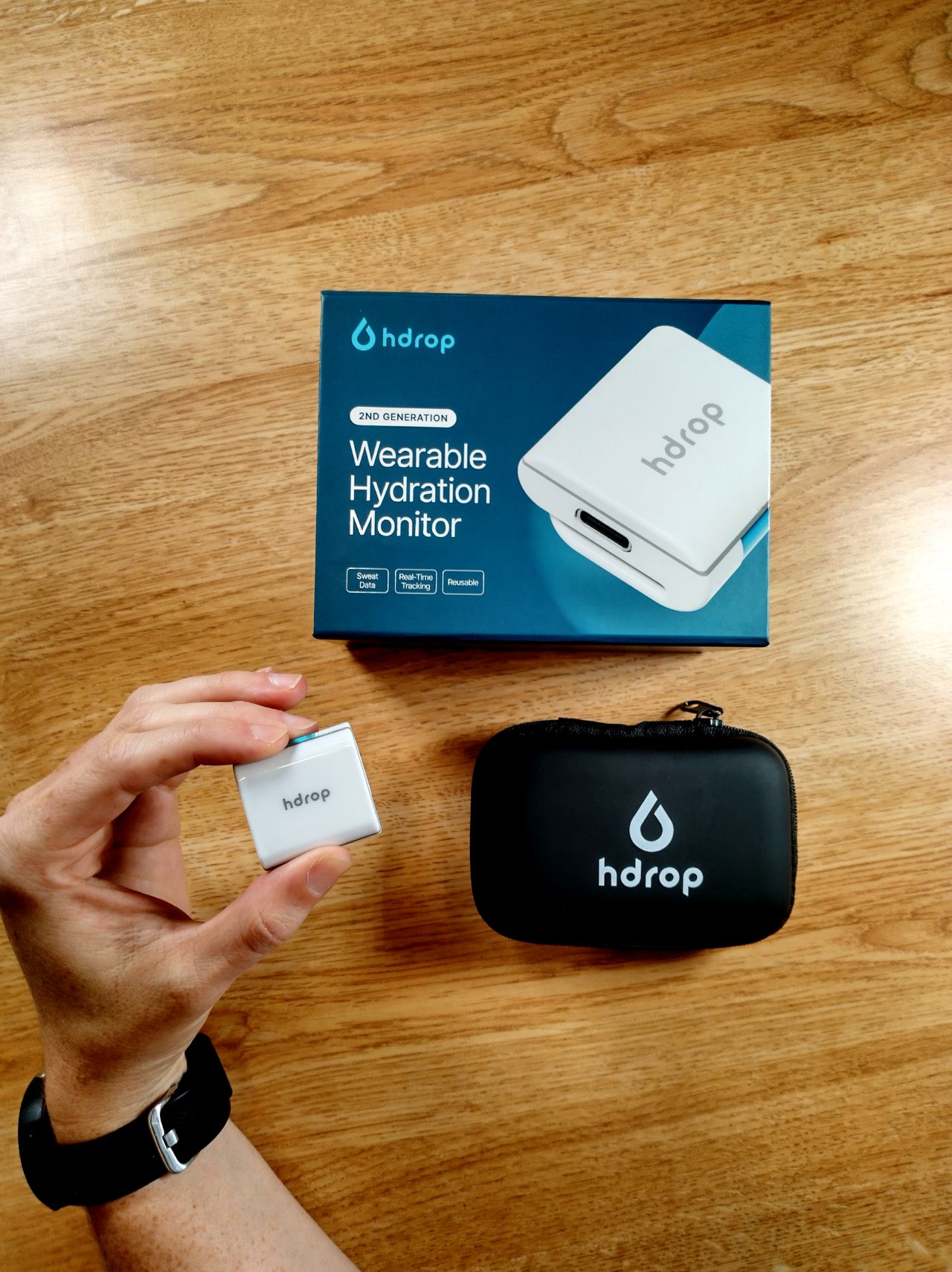
gen 2. seven years on from the rubber bands.
it also pushes to the hardware you're already staring at. garmin landed in 2021, hammerhead in 2023, trainingpeaks in 2025, and wahoo elemnt in june 2026, which matters if you'd rather read the number on your wrist or your bars than dig your phone out mid-effort. seven years, four integrations, largely bootstrapped. that pace tells you something about how this company operates.
adria recommends it once or twice a week depending on where you are in a season, as a way to track trends and recalibrate, though plenty of people wear it every day and he's glad they do. we've been closer to daily, mostly out of curiosity. sweat rate moves with heat, humidity, intensity, and how acclimated you are, so a number off one cool morning run doesn't tell you much about a hot afternoon effort. wearing it more often gives you a range instead of a single data point.
the scheduling link
if you have a problem with your hdrop, the app gives you a chatbot. if the chatbot can't sort you out inside three questions, you get a link to book a call. the call is with adria.
he's done more than a thousand of them. the small team helps now, but adria still takes the majority.
i know everything from the circuitry on the device down to the software down to the website, the sales, everything. when there's a problem, i'm usually able to find and pinpoint where the problem is coming from.
it's also the feedback loop. no ticket summary, no filtered report. a thousand athletes telling the founder directly what's broken and what they wish it did.
one device, eventually
right now a serious athlete stacks devices. watch on the wrist, strap on the arm, sensor somewhere else, three batteries to charge and three things to remember before a long day. having to remember all the gear can end up being a barrier to exercise as opposed to a benefit. adria thinks that ends with sweat sensing built into one wearable alongside everything else.
just imagine a single wearable able to track everything accurately, then you will not be using all of these things.
which is consistent with how he talks about all of it.
if we were to wrap up the company and start something new today, i will not regret it. i will not regret the journey. the hdrop journey has already been fulfilled and everything that we have right now is kind of like a gift.
our take
we feature hdrop because the odds were against two paper cups turning into an endurance business, but resilience and a commitment to learn has led the team forward. it's inspirational. a founder who built the thing to fix his own problem. a first production run assembled on folding tables with a podcast on. a support line that still ends at the founder's own calendar.
the sensor, band, and accompanying app are easy to set up and could easily stack on an existing hr armband if you use one. the device is barely noticeable on your arm but the post activity data carries real weight, with visuals inside the app showing how your sweat changes over the course of the effort. hydration recommendations come with the device. you test in real training conditions and update the stats as often as you like, which makes it a real value for anyone training for hours each week. the honest caveat is that this is a young technology in a category still proving itself, and adria says so more plainly than most people trying to sell you something. that said, hdrop has undergone independent scientific exercise validation, with approximately 92% accuracy for sweat-loss tracking and 87% for sodium-loss estimation. go see what they've built at hdroptech.com.